
The price you see on a national printer’s website is rarely the price you actually pay. By the time you add shipping for a box of 50 shirts, factor in handling fees, and realize you need expedited delivery to hit your deadline, that competitive quote looks a lot less competitive. And that’s before anything goes wrong in transit.
For Austin businesses ordering printed apparel in any real quantity, shipping costs aren’t a minor line item. They’re a budget variable that can swing wildly depending on weight, distance, carrier availability, and how badly you need those shirts to arrive on time. Local printing eliminates that variable entirely. No shipping fees. No carrier delays. No wondering whether your order is sitting in a warehouse in Memphis while your event is two days away.
The True Cost of Shipped Printing
Online printers advertise low per-shirt prices because that’s what catches your attention. But the total cost of an order includes everything that happens after production, and that’s where the math starts working against you.
Shipping fees scale with weight. A box of 25 lightweight tees might ship for a reasonable flat rate. But when you’re ordering 100 or 200 shirts, you’re looking at multiple heavy boxes crossing state lines. Ground shipping for a bulk apparel order can easily run $40 to $80 or more, depending on the carrier and distance. That cost comes straight out of your budget.
Rush shipping multiplies the damage. If your timeline is tight, standard ground won’t cut it. Expedited shipping for heavy packages gets expensive fast. Overnight or two-day delivery on a 50-pound order of printed shirts can cost more than the printing itself. And if you’re ordering from a printer two time zones away, you’re paying a premium just to fix a geography problem that didn’t need to exist.
Handling fees add up quietly. Many online printers charge handling fees, packaging fees, or fuel surcharges that don’t appear until checkout. These aren’t necessarily disclosed upfront, and they inflate your final invoice beyond what the initial quote suggested.
Returns and reprints compound the problem. If something arrives wrong, you’re not just waiting for a reprint. You’re waiting for another shipment. And depending on the printer’s policy, you might be covering return shipping on the defective order while also paying to receive the corrected one.
What You’re Really Paying For
When you order from a printer across the country, a significant portion of your total cost goes toward moving boxes, not making shirts. Consider what that money is actually buying you: fuel for trucks, labor at distribution hubs, packaging materials designed to survive a thousand-mile journey, and a carrier’s profit margin for the privilege of delivering it.
None of that adds value to your printed shirts. The quality doesn’t improve because the box traveled further. The design doesn’t look better because it crossed three state lines. You’re paying for logistics that exist only because you chose a printer who isn’t local.
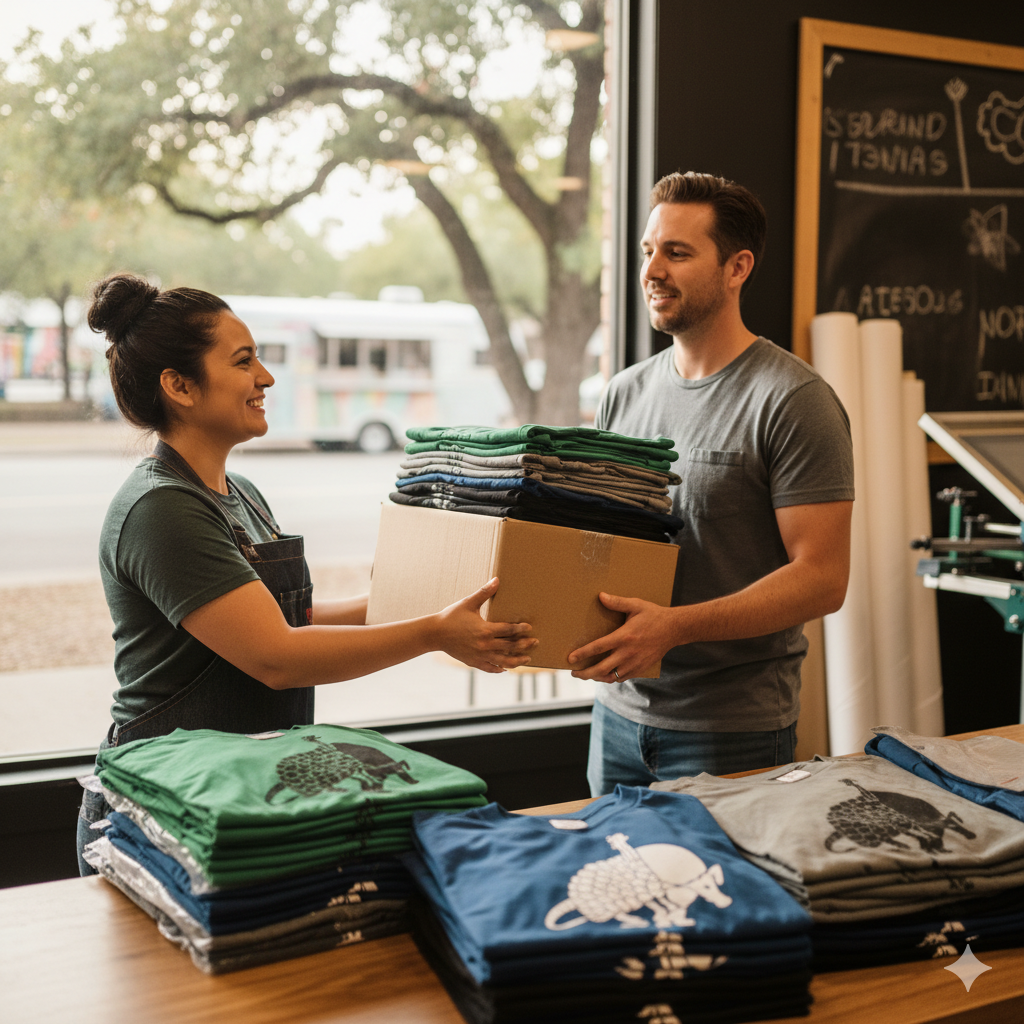
With a local Austin printer, that entire cost layer disappears. Your shirts get produced, you pick them up, and the transaction is done. No shipping invoice. No tracking anxiety. No wondering if the delivery driver will leave your boxes in the rain.
The Delay Risk Nobody Talks About
Shipping delays aren’t hypothetical. They happen constantly, and they happen for reasons completely outside your control. Weather disrupts flights and ground routes. Carrier networks get backed up during peak seasons. Packages get misrouted, stuck at transfer points, or marked as delivered when they’re sitting at a neighbor’s house three blocks away.
When your order is time-sensitive, these delays aren’t just inconvenient. They can derail entire projects. A software company in North Austin learned this the hard way when their product launch shirts got stuck at a FedEx hub for three extra days during a winter storm. The launch happened without the shirts. The team wore whatever they had. The branded photo op didn’t happen. The printer technically met their production deadline, but it didn’t matter because the carrier didn’t meet theirs.
Local pickup removes carrier reliability from the equation entirely. When your shirts are ready, you drive over and get them. The only variable is Austin traffic, and even that’s more predictable than a national logistics network.
When Bulk Orders Make Local Essential
The economics of local printing become even more compelling as order size increases. Shipping 25 shirts is one thing. Shipping 200 shirts is a completely different calculation.
A regional sales team needed 150 polos. Their corporate office in Chicago suggested using the company’s national vendor. The quote looked reasonable until shipping for six heavy boxes added nearly $200 to the order. The Austin office found a local printer, picked up the order themselves, and put that $200 back into the budget for a team lunch instead.
A nonprofit ordered volunteer shirts for their annual fundraiser. They needed 300 shirts across multiple sizes, which meant a heavy, bulky shipment. The out-of-state printer quoted $75 for ground shipping with a seven-day transit window. The event was nine days out. That left almost no margin for production delays, carrier issues, or last-minute size adjustments. They switched to a local shop, paid nothing for shipping, and had their shirts in hand with days to spare.
A growing brewery ordered company swag and branded apparel for their taproom staff and retail sales. Between shirts, hats, and koozies, the order was heavy and awkward to ship. Local production meant they could pick everything up in one trip, inspect the quality before leaving, and avoid the $120 shipping quote from the online alternative.
Comparing the Real Numbers
Let’s make this concrete. Say you’re ordering 100 printed t-shirts for your company. Here’s how the math typically breaks down:
National online printer: $7.50 per shirt ($750) + $65 ground shipping + $12 handling fee = $827 total. Transit time: 5-7 business days after production.
Local Austin printer: $8.00 per shirt ($800) + $0 shipping + $0 handling = $800 total. Pickup available same day production completes.
The “cheaper” online option actually costs more when you factor in shipping and fees. And that’s assuming everything goes smoothly. If you need rush delivery because the ground shipping timeline doesn’t work, the online option gets dramatically more expensive.
This math gets even more favorable for local printing as quantities increase. The per-shirt savings from a national printer shrink while shipping costs grow. At 200 or 300 shirts, local is almost always the better financial decision before you even consider the risk reduction.
Beyond Shirts: Where Shipping Costs Really Hurt
T-shirts are just the most common example. The shipping cost problem applies to any printed product with real weight or bulk. Screen printing for larger runs of hoodies, jackets, or heavyweight promotional items amplifies the issue. Embroidered polos and hats add weight fast. Even smaller items like koozies or bags become expensive to ship when you’re ordering in quantities that actually make sense for events or retail.
For Austin businesses ordering bulk orders of custom shirts or any significant quantity of printed goods, the local advantage compounds with every additional item. More volume means more shipping cost avoided. More weight means more savings kept in your actual project budget.
Why Pay to Ship Across the Country?
That’s the question more Austin businesses are asking. When a printer is twenty minutes away, paying to move boxes from North Carolina or Nevada doesn’t make sense. You’re not getting better quality. You’re not getting faster service. You’re getting a logistics chain that adds cost, adds risk, and adds uncertainty to every order.
Local printing gives you a final price that doesn’t change at checkout. It gives you a pickup date you can count on. And it gives you the ability to inspect your order before you leave, so there’s no waiting another week for a reprint if something isn’t right.
For bulk orders especially, the math is clear. Skip the shipping. Print local. Keep the savings.
────────────────────────────────────────────────────────────
Planning a bulk order? Let’s run the numbers together and show you what local pickup can save.